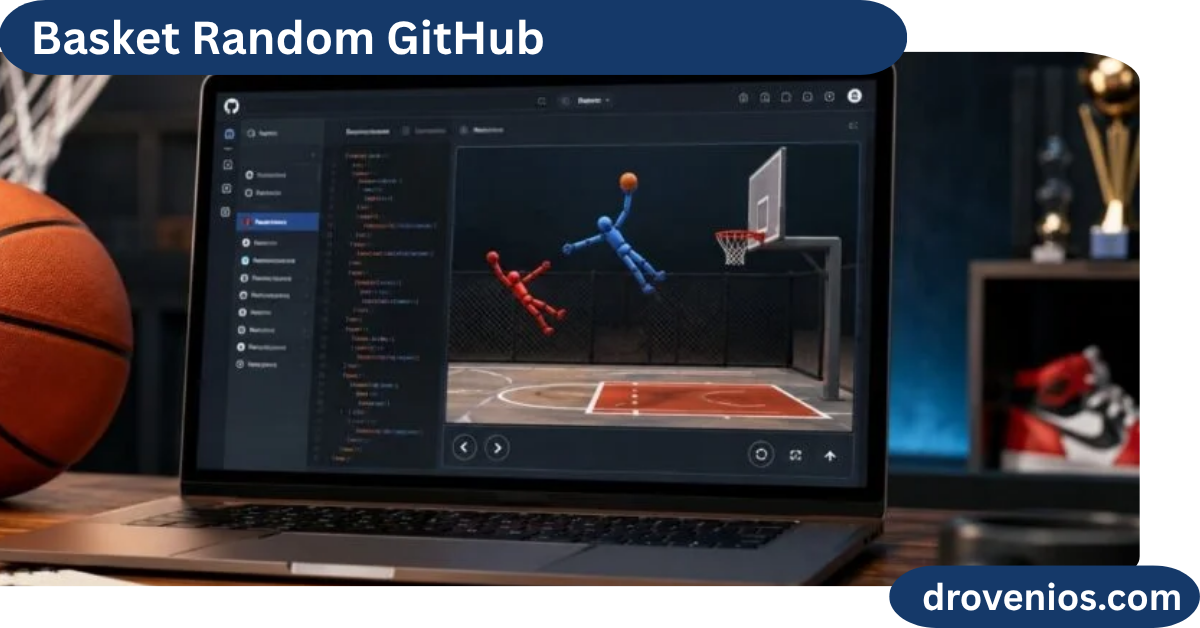
Basket Random GitHub: Complete Guide to the Game, GitHub Repositories, Code, Hosting, and Safety
If you have searched for “basket random github,” you may be looking for the Basket Random game, a GitHub repository containing the game files, a GitHub Pages version, or source code that can be studied and modified. The search phrase combines a popular casual basketball game with GitHub, the software development platform used to store, manage, share, and publish code.
Basket Random is known for its simple basketball gameplay and unpredictable physics. Instead of trying to create a realistic basketball simulation, the game uses unusual character movement and physics to make matches funny, quick, and unpredictable. This gives the game a very different feel from traditional basketball video games.
The GitHub side of the topic is more complicated. There is not one single GitHub repository that should automatically be treated as the official source code for the game. Search results include different repositories, forks, mirrors, game collections, and independent projects. For example, the public baseinfinite/basket-random repository contains files such as index.html, style.css, a scripts directory, and box2d.wasm.js. Another repository, NotJude/Basket-Random, describes itself as a basic basketball game written in Python for the NumWorks calculator.
That distinction is important. A GitHub repository containing files named “Basket Random” does not automatically prove that it is the original developer’s repository or that the game is open source.
This guide explains the topic in simple language and provides practical information for players, students, developers, teachers, and anyone researching Basket Random GitHub.
What Is Basket Random?
Basket Random is a casual two-player basketball game built around simple controls and unpredictable physics.
The main idea is easy to understand. Two players compete on a basketball court, try to score points, and attempt to stop the other side from scoring. The unusual physics can make characters jump, rotate, fall, or move in unexpected ways.

This randomness is an important part of the game’s identity.
Instead of requiring complicated combinations of buttons, the game focuses on simple interaction. That makes it easy for new players to understand while still creating unpredictable moments.
The game is commonly associated with browser gaming and casual multiplayer play. It has also appeared in online game collections and GitHub-hosted projects.
From a software perspective, a browser version can involve HTML, JavaScript, CSS, game assets, and a physics engine. One public GitHub repository associated with the name contains a box2d.wasm.js file, suggesting the use of Box2D-related WebAssembly technology in that particular project.
It is important to separate the game itself from repositories that copy, host, recreate, or otherwise reference it.
Also Read: Tsunaihaiya: Meaning, Origin, History, Cultural Context, and Modern Use
What Does “Basket Random GitHub” Mean?
The phrase “basket random github” can have several meanings.
A person searching this phrase may want to:
- Find a Basket Random game hosted on GitHub Pages
- Find GitHub repositories containing Basket Random files
- Study how a browser basketball game works
- Download or clone a repository
- Run a game locally
- Learn how physics-based browser games are structured
- Find a JavaScript or HTML game project
- Find a fork of an existing repository
- Investigate whether a game repository is legitimate
- Understand how GitHub Pages can host browser games
Therefore, the keyword should not be interpreted as the name of one specific GitHub project.
This is one of the most important things to understand when researching Basket Random GitHub.
Is Basket Random Officially Hosted on GitHub?
GitHub contains repositories and pages related to Basket Random, but the existence of a repository does not by itself establish that the repository is the official source maintained by the game’s original developer.
For example, the public baseinfinite/basket-random repository exists on GitHub and contains web-related game files. Its visible structure includes index.html, style.css, a scripts folder, and box2d.wasm.js. GitHub also shows that the repository has been forked.
Another repository, NotJude/Basket-Random, is clearly described as a basic basketball game made in Python for the NumWorks calculator. This is an example of why repository names need to be examined carefully. The same phrase can describe completely different projects.
There are also GitHub game collections containing a folder or entry named basket-random. One example is a large GitHub repository containing many browser games, including a Basket Random directory.
So, when someone asks for “Basket Random GitHub,” the first question should be:
“What exactly do you want from GitHub?”
Playing the game, studying code, downloading files, creating a fork, and finding the original developer are different tasks.
How GitHub Relates to Browser Games
GitHub is primarily a software development and collaboration platform.
Developers use GitHub to store repositories containing source code and other project files. A repository can include HTML files, JavaScript files, CSS files, images, audio, configuration files, documentation, and other resources.
For a browser game, a simple repository might contain:
- index.html
- JavaScript files
- CSS files
- Images
- Sound files
- Game configuration
- WebAssembly files
- Fonts
- Documentation
- Build files
A browser can load these resources and run the game.
GitHub Pages is especially useful for static websites because it can publish files from a repository as a website. This is one reason lightweight browser games sometimes appear on GitHub-hosted pages.
However, hosting a game on GitHub is different from owning the game.
A person may upload a game build without being the original creator. A repository can also be a fork or mirror of another project.
Basket Random GitHub Repositories to Know About
Search results for Basket Random GitHub show several types of repositories.
Dedicated Basket Random Repository
The baseinfinite/basket-random repository is one public example. Its visible files include HTML, CSS, scripts, and a WebAssembly-related JavaScript file.
This type of repository is useful for people who want to understand how a browser game can be organized.
However, repository ownership and licensing should always be checked before reusing its files.
Python Basket Random Project
The NotJude/Basket-Random project is different. Its GitHub description says it is a basic basketball game made in Python for the NumWorks calculator. The repository contains a main.py file and has a small commit history.
This is a useful example for beginners because it shows that “Basket Random” can also refer to an independently created basketball project rather than a copy of the well-known browser game.
Game Collection Repositories
Some GitHub repositories contain many browser games. Basket Random may simply be one directory among hundreds of games.
For example, one public repository contains a large collection of games and includes a basket-random entry.
These collections can be useful for studying how static browser games are organized, but they require extra attention to licensing and ownership.
Why Repository Names Can Be Confusing
GitHub allows users to create repositories with many different names.
Someone can create a repository called:
basket-random
Another person can create:
basket-random-game
Another can create:
basket-random-clone
Another could use:
basket-random-html5
These names do not automatically establish a relationship with the original game.
This is why a good GitHub search should look beyond the repository title.
Check:
- Repository owner
- README file
- License
- Commit history
- Contributors
- Release information
- Links to the original developer
- Website links
- File structure
- Copyright notices
- Whether the repository is a fork
- Whether the project explains where its files came from
This process is especially important if you plan to redistribute the files.
How to Find Basket Random on GitHub
You can search GitHub using several approaches.
Start with:
Basket Random
Then try more specific searches such as:
Basket Random game
Basket Random JavaScript
Basket Random HTML5
Basket Random GitHub Pages
basket-random index.html
basket random source code
These searches may produce different results.
The most useful repository is not necessarily the first result. A project with a clear README, understandable file structure, recent maintenance, and an appropriate license may be more useful for development research than a repository with a large number of forks but little documentation.
How to Check a Basket Random Repository
Before downloading anything, inspect the repository.
Check the README
The README often explains:
- What the project is
- Who created it
- How to run it
- Which technologies it uses
- Whether contributions are welcome
- What license applies
If there is no README, you may need to inspect the files manually.
Check the License
The license is one of the most important parts of a software repository.
A repository may be public without giving you unrestricted permission to copy, modify, or redistribute everything inside it.
Common open-source licenses include:
- MIT
- Apache License 2.0
- GPL
- BSD licenses
However, a repository can also contain third-party assets with separate restrictions.
If no license is provided, do not assume that the files are free for commercial reuse.
Check the Repository History
GitHub’s history can help show how a project developed.
A repository with only one commit may be a simple upload.
A repository with many commits may show longer development activity.
Neither situation automatically proves that a project is official or trustworthy, but history provides useful context.
For example, NotJude/Basket-Random currently shows one commit, while baseinfinite/basket-random shows three commits in the public repository view.
How to Understand the Files in a Basket Random GitHub Project
A browser game repository may look confusing at first.
Here are some common files and what they usually mean.
index.html
This is often the starting page for a browser application.
It can load:
- JavaScript
- CSS
- Images
- Game engines
- WebAssembly modules
For a simple game, opening the HTML page through a web server can start the game.
style.css
This file normally controls the visual layout.
It may define:
- Page dimensions
- Game canvas size
- Buttons
- Backgrounds
- Alignment
- Responsive behavior
- Mobile layout
JavaScript Files
JavaScript commonly controls browser game logic.
Depending on the project, JavaScript may manage:
- Keyboard input
- Game states
- Scores
- Character movement
- Physics
- Collision detection
- Animation
- Audio
- User interface
Assets
Game assets may include:
- Images
- Sprites
- Audio
- Fonts
- Backgrounds
- Animation data
These files can make up a large portion of a browser game’s total size.
WebAssembly
WebAssembly, often abbreviated as WASM, allows compiled code to run in a web browser.
The presence of a file such as box2d.wasm.js in a Basket Random repository is an example of a project using browser-compatible technology related to physics processing.
For beginners, the important idea is simple: WebAssembly can help browsers execute performance-sensitive code efficiently.
Why Physics Matter in Basket Random
The unusual physics are central to the game’s appeal.
Traditional basketball games usually try to make movement predictable. Basket Random takes the opposite approach.
Characters may have exaggerated movement. Their actions can interact with the ball, court, and other characters in surprising ways.
Also Read: Mypasokey: The Meaning, Search Intent, Safety, and Digital Literacy
From a programming perspective, physics systems often involve concepts such as:
- Gravity
- Velocity
- Acceleration
- Collision detection
- Mass
- Friction
- Forces
- Rotation
- Boundaries
A physics engine can calculate how objects respond when they collide or move through a simulated environment.
The result does not always need to be realistic.
In a casual game, unexpected behavior can actually make the game more entertaining.
Randomness Versus Physics
The word “random” can sometimes be misunderstood.
Randomness does not necessarily mean that every part of the game is completely arbitrary.
A game can combine deterministic physics with random variables.
For example, a game might randomly change:
- Player attributes
- Ball position
- Character size
- Court design
- Jump strength
- Direction
- Match conditions
The physics engine then calculates what happens after those values are selected.
This creates an important design principle:
Random input plus predictable physical rules can produce unpredictable outcomes.
That concept is useful far beyond basketball games.
It is also used in simulations, procedural generation, testing, artificial intelligence experiments, and game development.
Can You Download Basket Random From GitHub?
Some repositories may contain files that can be downloaded or cloned.
However, downloading a repository and receiving legal permission to redistribute its contents are two different things.
GitHub’s interface may allow you to download public files, but you should still review the repository’s license and ownership information.
If you only want to study the project on your computer, cloning a repository can be useful.
If you want to publish the project on your own website, modify it for public distribution, or use its assets in another commercial project, licensing becomes especially important.
How to Clone a Basket Random GitHub Repository
If you have identified a repository that you are legally permitted to use, Git can clone it onto your computer.
A typical command looks like this:
git clone https://github.com/OWNER/REPOSITORY.git
You would replace OWNER/REPOSITORY with the repository you have chosen.
After cloning, move into the project directory:
cd REPOSITORY
The exact next step depends on the project.
A static HTML game may not require a complicated build process.
A project created with a game engine or modern JavaScript framework may require additional software.
Always read the project’s README before running commands.
How to Run a Browser Game Locally
Many static browser projects work best through a local web server.
For example, Python includes a simple development server.
From the project directory, you can use:
python -m http.server 8000
Then open:
http://localhost:8000
This approach can be more reliable than opening an HTML file directly.
Some browser features expect HTTP requests and may not behave correctly when a file is opened with a file:// address.
If the project uses Node.js, it may instead provide an npm-based workflow.
The correct procedure depends on the repository.
Why Opening index.html May Not Work
Beginners often download a browser game and double-click index.html.
Sometimes it works.
Sometimes it does not.
Modern web applications can use:
- JavaScript modules
- Fetch requests
- WebAssembly
- Service workers
- Relative asset paths
- Browser security rules
Some of these features work differently when a page is loaded directly from the filesystem.
A local development server provides a more normal web environment.
This is one reason developers commonly use tools such as Python’s built-in server or Node-based development servers.
Can You Modify Basket Random?
Technically, modification may be possible when you have access to editable source code and the necessary rights to modify it.
Possible changes in a game project might include:
- User interface changes
- New backgrounds
- Different controls
- New scoring rules
- Different physics parameters
- Sound changes
- Responsive layout improvements
- Accessibility improvements
- New game modes
But technical ability and legal permission are separate questions.
You may be able to edit a file while still lacking permission to redistribute someone else’s copyrighted game or assets.
Therefore, developers should examine the license before publishing modifications.
Building Your Own Basket Random-Style Game
If your real goal is learning game development, creating an original basketball game inspired by the general concept can be a useful project.
You do not need to copy the original game.
Instead, you can build your own version using:
- HTML
- CSS
- JavaScript
- Canvas
- WebGL
- A JavaScript game framework
- A physics engine
The basic architecture might look like this:
- Create a game canvas.
- Draw the basketball court.
- Create player objects.
- Create the basketball.
- Add gravity.
- Add collision detection.
- Add keyboard controls.
- Add scoring.
- Add a game timer or score limit.
- Add random events.
- Add sound and visual effects.
- Test the game.
- Publish it using a suitable hosting service.
This approach gives developers more control and avoids unnecessary copying of protected game assets.
A Simple Architecture for a Basketball Browser Game
A basic game can be divided into several systems.
Input System
The input system receives keyboard or controller actions.
For example:
Space = Player 1 action
Arrow Up = Player 2 action
The exact controls depend on the game design.
Physics System
The physics system calculates movement.
It may track:
- X position
- Y position
- Horizontal velocity
- Vertical velocity
- Gravity
- Rotation
Collision System
The collision system determines whether objects touch.
For example:
- Player and ball
- Ball and hoop
- Player and floor
- Ball and backboard
Game State
The game state determines whether the game is:
- Starting
- Playing
- Paused
- Scoring
- Finished
Rendering System
The rendering system draws everything on the screen.
It may display:
- Players
- Ball
- Court
- Score
- Timer
- Game-over screen
Separating these systems makes a project easier to understand and maintain.
How Randomness Can Be Added to a Basketball Game
A developer can add controlled randomness without making the game completely unpredictable.
For example, random values can affect:
- Character height
- Jump strength
- Ball starting position
- Court selection
- Wind
- Bounce strength
- Character movement
A simple JavaScript random function might produce a value between zero and one.
For example:
Math.random()
A developer can then transform that value into a useful game parameter.
The important design question is not simply “How much randomness should I add?”
It is:
“How can randomness create interesting decisions without making player skill meaningless?”
This is a valuable lesson in game design.
Basket Random GitHub and Game Development Education
A repository related to a simple basketball game can be useful for students.
Students can learn about:
- HTML structure
- JavaScript
- CSS
- Game loops
- Event listeners
- Collision detection
- Random number generation
- Physics
- Git
- GitHub
- Version control
- Web hosting
A small game can therefore become a practical programming exercise.
Instead of studying each concept separately, students can see how multiple concepts work together.
For example, a keyboard event triggers JavaScript. JavaScript changes the player’s velocity. The physics system updates the position. The renderer displays the new position.
That is the foundation of many interactive applications.
GitHub Forks and Basket Random Projects
A fork is a copy of a repository under another GitHub account.
Forks are useful for experimentation and independent development.
However, a fork does not erase the original license.
If the original repository uses an open-source license, the license generally continues to govern how the copied project can be used.
If there is no clear license, developers should be cautious.
A common mistake is assuming:
“It is on GitHub, so I can use it anywhere.”
That is not a safe assumption.
Public visibility and public-domain status are not the same thing.
Copyright and Basket Random GitHub
Copyright is an important issue when dealing with game files.
A game can contain many protected elements, including:
- Artwork
- Character designs
- Music
- Sound effects
- Code
- Logos
- Written content
- Other creative assets
Even if a repository contains copies of those files, the uploader may not own all of them.
Therefore, a developer should not assume that every file in a repository can be reused simply because it is publicly accessible.
When in doubt, look for:
- License information
- Copyright statements
- Original developer information
- Permission notices
- Third-party asset licenses
For commercial projects, obtaining appropriate legal advice can be useful.
Is a Basket Random GitHub Repository Safe?
Safety depends on the specific repository.
GitHub itself is a major software development platform, but individual repositories are created by different users.
You should not assume that every repository is safe simply because it is hosted on GitHub.
Before running unfamiliar code, consider:
- Who owns the repository?
- Is the project documented?
- How old is it?
- What files does it contain?
- Does it ask you to install unusual software?
- Does it require administrator access?
- Does it contain suspicious scripts?
- Are external downloads clearly explained?
- Is there a recognizable license?
- Does the repository have a reasonable history?
A browser game that only contains ordinary static web files presents a different risk profile from an unknown executable installer.
Avoid Suspicious Game Downloads
Be cautious when a website claims that you need to install:
- A browser extension
- A special launcher
- An unknown executable
- A “game booster”
- A certificate
- A system update
- A suspicious browser plugin
A lightweight browser game normally should not require random system software.
Do not disable antivirus protection simply because a download tells you to do so.
Do not provide passwords or financial information to access an ordinary casual game.
Privacy Considerations
A browser game can potentially collect information depending on how it is hosted and coded.
Possible information collected by websites can include:
- IP address
- Browser type
- Device information
- General usage information
- Cookies
- Analytics data
The exact information depends on the website and its services.
A GitHub repository containing static files does not automatically tell you everything about the privacy practices of a website that uses those files.
A third-party website can add its own analytics, advertisements, trackers, or scripts.
This is why users should distinguish between:
- A GitHub repository
- A GitHub Pages site
- A third-party game portal
- A mirror website
They may not have the same privacy practices.
GitHub Pages and Basket Random
GitHub Pages is designed to publish websites from repositories.
This makes it useful for static projects.
A browser game that consists of client-side files can sometimes be hosted this way.
A typical structure might contain:
index.html
style.css
game.js
assets/
When published, the browser requests these files from the website and executes the client-side code.
This is fundamentally different from a traditional game server that performs most of the processing on a remote server.
Why GitHub Pages Is Popular for Small Games
GitHub Pages is attractive for developers because it can make simple websites available without managing a traditional web server.
For a small game, the developer can maintain:
- Code
- Assets
- Documentation
- Version history
in one repository.
It can also make development easier because changes can be tracked through Git.
For students, this provides a practical way to learn both programming and basic web deployment.
Common Problems With Basket Random GitHub Projects
A repository may fail to work for several reasons.
Broken Asset Paths
The HTML may expect assets in a particular directory.
If files are moved, the game may show a blank screen.
Missing Files
A repository may depend on files that are not included.
Browser Compatibility
Older game builds may behave differently in modern browsers.
WebAssembly Issues
A WebAssembly component may fail because of incorrect paths, server configuration, browser restrictions, or incomplete downloads.
JavaScript Errors
A script error can prevent the game from starting.
The browser’s developer console can often provide clues.
Outdated Projects
A repository may have been created years ago and no longer receive maintenance.
This does not necessarily make it useless, but it means you may need to troubleshoot it yourself.
How Developers Can Troubleshoot a Basket Random Repository
Start with the browser developer tools.
In Chrome or another Chromium-based browser, you can open Developer Tools and inspect:
- Console
- Network
- Sources
- Application
The Console can reveal JavaScript errors.
The Network panel can show whether files failed to load.
If you see a missing file with a 404 response, check whether the expected file actually exists in the repository.
If the game loads but does not respond to keyboard input, check whether the page or game canvas has focus.
If WebAssembly fails, inspect the Network and Console panels for loading or MIME-related errors.
These basic techniques are useful far beyond Basket Random.
Basket Random GitHub for Beginners
If you are new to programming, do not start by trying to understand every file.
Use a gradual approach.
First, locate index.html.
Then identify the JavaScript files.
Look for event listeners.
Search for terms such as:
- keydown
- keyup
- score
- player
- ball
- collision
- gravity
- gameLoop
These words can help you understand how the game works.
Next, identify how the game updates the screen.
You do not need to understand every line immediately.
Programming becomes easier when you break a large project into smaller systems.
How to Learn From a Basket Random-Style Project
A good learning path is:
Step 1: Learn Basic HTML
Understand elements, attributes, scripts, and page structure.
Step 2: Learn CSS
Learn how pages are styled and positioned.
Step 3: Learn JavaScript
Understand variables, functions, conditions, loops, objects, and events.
Step 4: Learn Canvas
Canvas allows JavaScript to draw graphics in a web page.
Step 5: Learn Game Loops
A game loop repeatedly updates the game state and redraws the screen.
Step 6: Learn Collision Detection
Learn how the game determines when objects interact.
Step 7: Learn Physics
Study gravity, velocity, acceleration, and forces.
Step 8: Learn Git
Understand commits, branches, repositories, and history.
Step 9: Learn GitHub
Learn cloning, forking, pull requests, and repository management.
Step 10: Build Your Own Game
Start with something small.
A basic two-player basketball game can be an excellent programming project.
What Makes Basket Random Different From Traditional Basketball Games?
The biggest difference is the design goal.
A traditional basketball simulator may focus on realistic movement, accurate player statistics, detailed courts, and complex controls.
Basket Random-style gameplay focuses more on simplicity and surprise.
This makes it accessible to people who do not normally play sports games.
A match can be understood quickly.
The unpredictability also creates humor.
A strange bounce or unexpected character movement can completely change a play.
That is not necessarily a technical flaw.
In this type of game, unexpected behavior can be part of the intended experience.
Basket Random as an Example of Emergent Gameplay
One interesting lesson from physics-based games is emergent behavior.
Emergent behavior happens when relatively simple rules combine to create outcomes that are difficult to predict.
Imagine a game with:
- Gravity
- A bouncing ball
- Two moving characters
- A basketball hoop
- Collision detection
- Random movement
Each rule may be simple.
When the rules interact, however, the resulting situation can become surprising.
This is one reason physics-based games can remain entertaining even when the basic controls are simple.
Can Basket Random Be Used to Learn JavaScript?
A Basket Random-style project can be a useful JavaScript learning example.
Also Read : Nahttypen: A Complete Guide to Seam Types in Sewing and Garment Construction
You can study how:
- Keyboard input is captured
- Variables store game states
- Objects represent players
- Functions perform actions
- Random numbers generate variation
- Loops update gameplay
- Canvas renders graphics
- Collision systems detect contact
If the existing project is difficult to understand, creating a small game from scratch may actually be easier.
For example, begin with one square representing a player and one circle representing a ball.
Add gravity.
Then add movement.
Then add a hoop.
Finally, add scoring.
This approach teaches the same core ideas without requiring you to understand a large existing codebase.
How to Choose Between a Repository and Building From Scratch
Use an existing repository when your goal is to study a working example.
Build from scratch when your goal is to learn how the system works.
Use a fork when you have permission to modify and distribute the project according to its license.
Use a completely original project when you want maximum control over your design and intellectual property.
For students, building a smaller original version can often produce better learning than copying a finished game.
Common Search Intent Behind “Basket Random GitHub”
The keyword has several types of search intent.
Informational Intent
The user wants to understand what Basket Random GitHub means.
Navigational Intent
The user wants to find a particular GitHub repository or GitHub Pages website.
Developer Intent
The user wants to inspect or modify game files.
Educational Intent
The user wants to learn how browser games are created.
Troubleshooting Intent
The user has downloaded or cloned a project and wants to make it work.
Hosting Intent
The user wants to publish a browser game using GitHub Pages.
Understanding these different intents is useful for both users and developers.
Basket Random GitHub and SEO Search Results
Search results can contain a mixture of official pages, repositories, mirrors, articles, and unrelated projects.
This creates an SEO challenge.
A page ranking for “basket random github” should clearly explain what the phrase means instead of assuming that every searcher wants the same thing.
Good informational content should distinguish between:
- The original game
- GitHub repositories
- GitHub Pages
- Forks
- Mirrors
- Independent clones
- Game collections
- Source-code examples
This distinction improves clarity and helps users avoid confusing unrelated projects.
How to Verify Information About a GitHub Game
When researching an unfamiliar repository, use several signals.
First, look at the GitHub repository itself.
Second, inspect the project’s documentation.
Third, check whether the claimed owner is connected to the game.
Fourth, inspect the license.
Fifth, compare repository files with information from the game’s developer or established sources.
Do not rely only on a random article claiming that a particular repository is “official.”
The current public GitHub search landscape shows that several different Basket Random-related repositories and projects exist.
Frequently Asked Questions About Basket Random GitHub
1. Does GitHub own Basket Random?
No. GitHub is a software hosting and collaboration platform. A GitHub repository can contain files related to a game, but that does not mean GitHub owns the game.
2. Is every Basket Random repository the same game?
No. Repository names can be reused. Some repositories may contain a browser build, some may contain an independent basketball game, and others may be game collections. For example, NotJude/Basket-Random describes a Python basketball game for the NumWorks calculator, while baseinfinite/basket-random contains a browser-oriented file structure.
3. Can a GitHub repository containing Basket Random be used commercially?
That depends on the applicable license and ownership of the individual files. Public availability does not automatically provide commercial redistribution rights. Review the repository license and third-party asset rights before commercial use.
4. Why does a Basket Random repository contain WebAssembly files?
Some browser games use WebAssembly to run compiled code in the browser. The baseinfinite/basket-random repository, for example, includes box2d.wasm.js among its visible files.
5. Can I create my own basketball game inspired by Basket Random?
Yes, you can create an original basketball game using your own code, graphics, sounds, characters, and designs. The safest development approach is to build your own implementation rather than copying protected assets or code without appropriate permission.
Final Thoughts on Basket Random GitHub
The keyword “basket random github” connects casual gaming with software development, web hosting, GitHub repositories, JavaScript, physics, and digital literacy.
Basket Random is known for its simple basketball gameplay and unusual physics. GitHub, meanwhile, provides a place where developers can store, inspect, fork, and publish software projects.
The important point is that there is no reason to assume every repository named Basket Random is the official source of the game.
Current public GitHub results show several different projects. The baseinfinite/basket-random repository contains a browser-oriented structure with HTML, CSS, scripts, and a WebAssembly-related file, while NotJude/Basket-Random is described as a Python basketball project for the NumWorks calculator. Large game collections can also contain Basket Random as one title among many.
For players, the main lesson is to be careful when visiting third-party mirrors or downloading unknown files.
For developers, the main lesson is to inspect the repository, understand its technology, and check its license before using or redistributing anything.
For students, Basket Random-style projects can provide a practical way to learn JavaScript, HTML, physics, game loops, Git, and GitHub.
Most importantly, GitHub should be treated as a development platform rather than a guarantee that every uploaded project is official, open source, or safe to reuse. A careful review of the repository, its history, documentation, license, and files can help you understand exactly what you have found.
That approach makes the search for “basket random github” much more useful. Instead of simply finding a page that contains the game, you can understand where the files came from, how the technology works, what you are legally allowed to do with the code, and how browser games can be built and hosted.