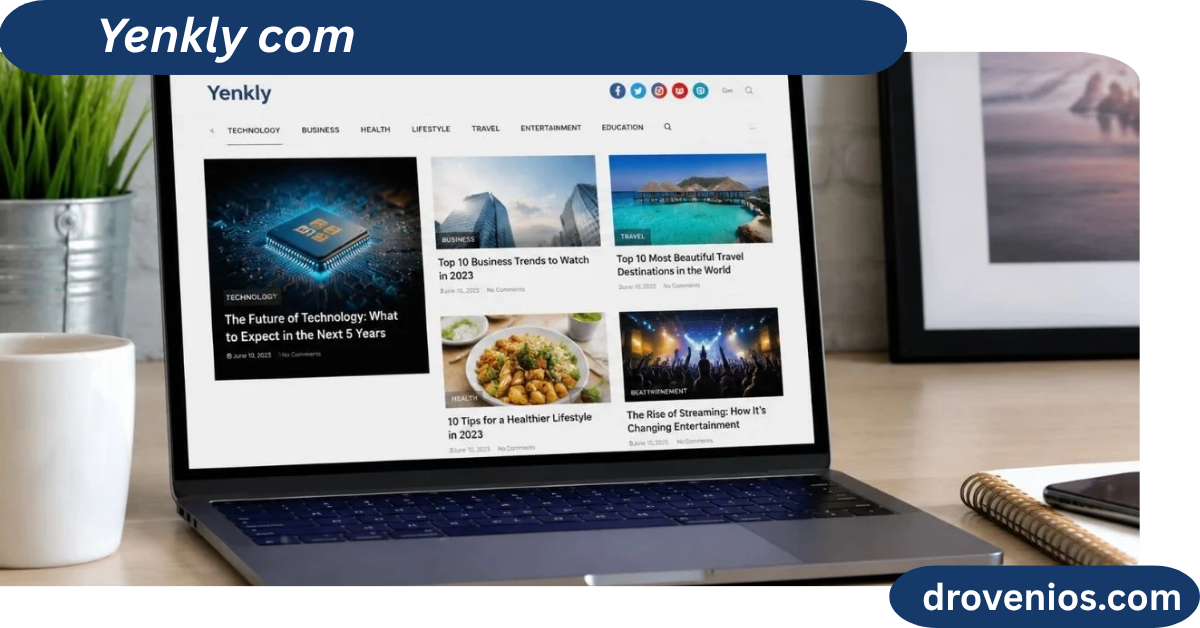
Yenkly com: A Complete Guide to the Multi-Niche Blog and Online Publication
Yenkly com is described as a multi-niche blog and online publication that brings together information from several different areas. Instead of focusing on one narrow subject, the platform covers a broad mix of topics such as technology, business, health, lifestyle, travel, education, entertainment, and other general-interest subjects.
This type of website is often called a multi-niche blog, general-interest website, or digital publication. The main idea is simple: readers can find articles about different parts of everyday life in one place.
Current third-party descriptions of Yenkly com present it as an informational publishing platform rather than a website built around one specialized service. They describe its content model as covering several major categories, with technology, business, health, lifestyle, travel, education, and entertainment appearing among the topics associated with the site.
For someone searching for “yenkly com,” the most useful starting point is therefore to understand what kind of website it is, what readers may find there, how to evaluate its articles, and how to use a broad online publication safely.
Because online websites can change their categories, authors, policies, and content over time, individual pages should always be checked for their publication date and current information.
Yenkly com at a Glance
Yenkly com can be understood through a few simple points:
- It is associated with a multi-niche blog model.
- Its content covers several broad subject areas.
- Technology is one of the areas associated with the publication.
- Business and entrepreneurship are also part of its broader content focus.
- Health and well-being topics are included.
- Lifestyle and everyday-interest subjects may also appear.
- Travel, education, entertainment, and trending topics have been associated with its wider content range.
- The site is better understood as a general information resource than as a specialized professional service.
- Readers should verify important claims through reliable primary or specialist sources.
This last point is important. A multi-niche publication can be useful for learning and discovering topics, but not every subject has the same level of risk.
For example, a general technology article may help explain a new digital term. A health article, however, may involve information that affects someone’s personal medical decisions. Financial, legal, and cybersecurity subjects can also require more careful verification.
Why Is Yenkly com a Multi-Niche Website?
A multi-niche website does not stay inside one subject area.
A specialized website may publish only about smartphones, dental care, investing, travel, or cooking. A multi-niche blog takes a wider approach. It may publish a technology guide on one day, a business article on another day, and a lifestyle or health article later.
Yenkly com follows this broader publishing model.
There is a practical reason for this structure. Internet users often have many different questions. Someone may search for a technology explanation in the morning and a travel idea later in the week. A broad publication can serve readers who enjoy exploring different subjects.
The model can also help readers discover topics they were not originally searching for.
For example, a person who arrives at a technology article may notice related business content about digital work. Another reader may find a lifestyle article after reading about health and wellness.
This creates a type of content ecosystem where several interests exist under one website.
What Topics Does Yenkly com Cover?
The exact categories on an online publication can change over time. Based on current descriptions available about Yenkly com, its wider content areas include technology, business, health, lifestyle, travel, education, entertainment, and trending subjects.
Each category serves a different type of search intent.
Also read:gd7 playz.blogspot/2025/03/rbs.html: Complete Guide, Meaning, Safety, and What Users Should Know
Technology
Technology is one of the major areas associated with Yenkly com.
Technology content can include explanations of digital tools, online services, devices, software, artificial intelligence, internet trends, cybersecurity concepts, and other technology-related subjects.
Technology changes quickly. A useful technology article should therefore make it clear when the information was written or updated.
A reader searching for an old software feature, for example, may find that the interface or function has changed. The same can happen with smartphone features, artificial intelligence tools, online platforms, and operating systems.
When reading technology content on Yenkly com or another general blog, always consider the age of the article.
Business
Business is another important category in the broader Yenkly com content model.
Business articles can appeal to entrepreneurs, employees, students, freelancers, small-business owners, and general readers who want to understand how companies and markets work.
Possible business subjects include entrepreneurship, marketing, workplace trends, online business, company strategies, productivity, digital transformation, and general business concepts.
Business articles can be useful for learning basic ideas. However, general online content should not automatically be treated as professional financial, legal, tax, or investment advice.
If a decision involves a large amount of money or a legal obligation, readers should consult appropriate professional or government resources.
Health and Wellness
Health is another subject associated with Yenkly com.
Health content is especially popular on the internet because people frequently search online when they have questions about symptoms, nutrition, exercise, wellness, medications, and everyday health habits.
However, health information requires more caution than many general-interest topics.
An online article can explain a health concept, but it cannot replace an examination, diagnosis, or personalized medical advice from a qualified healthcare professional.
Readers should be especially careful with articles that make strong claims about treatments, cures, supplements, or serious medical conditions.
A useful health article should distinguish general educational information from individual medical advice.
Lifestyle
Lifestyle is a broad category that can include everyday habits, home life, personal interests, productivity, relationships, routines, wellness, and practical living.
Lifestyle content is naturally suited to a multi-niche publication because it connects with many other categories.
For example, technology affects modern work and daily routines. Business affects personal productivity and careers. Health connects with food, exercise, sleep, and lifestyle choices.
This makes lifestyle a useful bridge between different subjects.
Travel
Travel is another area associated with the wider Yenkly com content range.
Travel articles can provide destination ideas, planning information, cultural background, transportation suggestions, sightseeing ideas, and general travel guidance.
Travel information can become outdated quickly.
Airline policies change. Visa rules change. Hotel prices change. Attractions can change their opening hours. Transportation systems can change routes or schedules.
For that reason, a travel article should be treated as a starting point rather than the final authority for time-sensitive travel decisions.
Before booking an expensive trip, readers should confirm important details through official airline, government, hotel, tourism, or transportation websites.
Education
Education content can serve students, parents, teachers, professionals, and lifelong learners.
A general education article might explain a subject, describe a learning method, discuss career-related ideas, or introduce a new concept.
Education and technology also overlap heavily today. Online learning platforms, artificial intelligence tools, digital classrooms, educational software, and remote learning have changed how people access information.
Yenkly com’s multi-topic structure can therefore connect education with technology, business, and career topics.
Entertainment and Trending Topics
General-interest publications often include entertainment and trending content because these subjects attract readers who want quick information about topics receiving public attention.
Entertainment may include movies, television, popular culture, celebrities, digital trends, or other current interests.
Trending information should be handled carefully because it can change rapidly.
A story that appears accurate in the morning may receive important updates later the same day. Readers should therefore look for publication dates, updates, named sources, and supporting evidence when a trending story matters.
What Is the Search Intent Behind “Yenkly com”?
Someone searching for “yenkly com” may have several different reasons.
The first possibility is navigational intent. The person may simply want to find the website.
The second possibility is informational intent. The user may have encountered the domain and want to understand what it is.
The third possibility is trust-related intent. A person may be asking whether the website is useful, reliable, safe, or worth reading.
The fourth possibility is content-related intent. Someone may have seen an article from the site and want to learn more about the publication behind it.
Understanding these different search intents is important because the best answer depends on what the person actually wants.
If the goal is simply to visit the site, the domain itself is the relevant destination. If the goal is to evaluate information found on the site, then the individual article should be examined carefully.
Is Yenkly com a News Website?
Yenkly com is more accurately described in available third-party material as a broad online publication or multi-niche blog rather than automatically being treated as a traditional news organization.
That distinction matters.
A traditional newsroom may have dedicated reporters, editors, fact-checking systems, correction procedures, and established reporting standards. A general blog can have a different publishing structure.
Also read:Syrenis Strategic Initiatives: A Complete Guide to Strategy, Growth, and Sustainable Success
This does not automatically make one format good or bad.
Instead, readers should evaluate the actual page.
Look at the author, publication date, sources, evidence, claims, and purpose of the article. If the article reports a major event, compare it with reliable primary sources and established news organizations.
How Reliable Is Yenkly com?
Reliability should be evaluated at the article level as well as the website level.
There is not enough independently verified public information in the current search results to make a blanket claim that every Yenkly com article is authoritative or that every article should be considered unreliable.
A better approach is to ask specific questions.
Who wrote the article?
When was it published?
Has it been updated?
Does it provide evidence?
Does it identify its sources?
Are the sources appropriate for the subject?
Does the article separate facts from opinions?
Does the writer appear to have relevant expertise?
Are important claims supported by primary or trustworthy secondary sources?
These questions are useful because different subjects require different levels of evidence.
For example, a basic lifestyle article may not need the same evidence as a medical article. A technology opinion piece is different from a cybersecurity warning. A travel inspiration article is different from immigration advice.
How to Evaluate a Yenkly com Article
One of the best ways to use any multi-niche blog is to become an active reader rather than accepting every statement automatically.
Start with the headline.
Does the headline accurately describe the article? Or does it make a promise that the content does not support?
Next, check the author.
A clear byline can help readers understand who created the content. For specialized subjects, relevant qualifications or experience can also provide useful context.
Then check the date.
This is particularly important for technology, health, business, finance, law, travel, and current events.
After that, examine the evidence.
Does the article explain where important facts came from? Are there links to official organizations, research, government agencies, product documentation, or other reliable sources?
Finally, compare important claims.
Google’s own guidance recommends people-first content that provides original value, clear expertise, reliable information, and substantial answers rather than simply rewriting material from elsewhere.
The same principle is useful for readers. Content should provide enough information to understand the subject, not simply repeat a popular claim.
Yenkly com and Technology Information
Technology changes quickly, so readers should always check the date of an article on Yenkly com. Information about AI tools, apps, smartphones, software, social media, and cybersecurity can become outdated as features and policies change. Before relying on technical information, check the publication or update date and compare important details with the official website or documentation. This simple step can help you avoid using outdated information.
Yenkly com and Health Information
Health information requires an even more careful approach.
If a Yenkly com article discusses nutrition, exercise, common symptoms, wellness, or general health education, it can potentially serve as introductory reading.
But readers should not use a general blog article as a personal diagnosis.
For medical questions, look for information from established medical institutions, government health agencies, professional medical organizations, and qualified healthcare professionals.
Be cautious when an article uses phrases such as “guaranteed cure,” “works for everyone,” or “doctors do not want you to know.”
Health problems can have different causes, and individual treatment depends on a person’s history, symptoms, medications, age, and other factors.
A responsible reader should therefore use online health articles for education and then seek appropriate professional advice when needed.
Yenkly com and Business Information
Business content can be useful for learning basic concepts, but financial decisions require additional care.
Suppose an article discusses investing, taxes, loans, business registration, employment law, or financial planning.
These areas can involve rules that differ by state, country, business structure, income level, or individual circumstances.
A general article may explain the basic concept, but it may not account for every situation.
For U.S. readers, official government resources and qualified professionals can provide more appropriate information when a decision involves taxes, legal obligations, investments, or regulated financial products.
This does not mean a general business blog has no value.
It can help a reader understand the vocabulary and basic questions to ask before moving to more specialized information.
Privacy Considerations When Visiting Yenkly com
Privacy is important whenever you visit an unfamiliar website.
A website may collect information through cookies, analytics systems, forms, account registration, advertising technologies, or other tools.
The exact data practices of a website should be confirmed through its current privacy policy rather than assumed.
Before submitting personal information, check whether the site clearly explains:
- What information it collects
- Why it collects the information
- Whether information is shared with third parties
- How long information is retained
- How users can contact the operator
- Whether users can request access or deletion where applicable
- What cookies or tracking technologies are used
The Federal Trade Commission advises consumers to understand how websites and apps collect, use, share, and protect personal information before using them.
This is a useful habit for Yenkly com and any other unfamiliar website.
Is HTTPS Enough to Prove a Website Is Safe?
No, HTTPS alone does not prove that a website is safe or trustworthy. It encrypts the connection between your browser and the website, but even scam websites can use HTTPS. When visiting Yenkly com or any unfamiliar site, check the domain name, review its policies, look for independent information, avoid unexpected downloads, and do not share unnecessary personal or payment information. HTTPS is helpful for security, but it should not be your only safety check.
Can You Trust Every Article You Find on Yenkly com?
No website should receive automatic trust simply because it publishes information.
The correct approach is article-by-article evaluation.
For simple topics, an article may be enough to provide a useful introduction.
For important subjects, use additional sources.
This is especially important for:
- Medical decisions
- Financial decisions
- Legal questions
- Immigration information
- Cybersecurity
- Personal safety
- Government requirements
- Current travel rules
- Major purchases
The more serious the consequence of being wrong, the stronger your verification process should be.
How to Check Information From Yenkly com
A simple verification method is the “three-check” approach.
First, check the source.
Ask where the information came from.
Second, check the date.
Ask whether the information is still current.
Third, check another reliable source.
If two independent and trustworthy sources agree, your confidence can increase.
For highly important claims, go one step further and find the original source.
For example, if an article discusses a government rule, look for the relevant government website.
If it discusses a medical recommendation, look for the appropriate medical organization.
If it discusses software, check the developer’s official documentation.
This is stronger than simply comparing two blogs that copied the same information.
How to Stay Safe When Clicking Links
External links are a normal part of the web, but readers should still pay attention.
Before clicking an unfamiliar link, look at the destination.
If the link asks you to download a file unexpectedly, stop and reconsider.
If a page suddenly asks for a password, financial information, or personal identification, verify that you are on the correct website.
Also read:Messagenal: A Complete Guide to Clear and Meaningful Digital Communication
The FTC recommends researching unfamiliar sellers and websites and checking terms, policies, and independent information before sharing sensitive information or making payments.
These habits are useful even when you are simply reading articles.
What Makes a Multi-Niche Blog Useful?
The biggest advantage of a multi-niche blog is variety.
Readers can explore different topics without changing websites.
A person interested in technology may also find business content useful. A student may be interested in education and career topics. Someone reading health information may also explore lifestyle content.
This broad structure can make a website convenient for casual learning.
Another advantage is topic discovery.
Sometimes people do not know exactly what they want to search for. Reading a well-organized article can introduce a new subject and lead to more focused research.
However, variety should not be confused with specialized expertise.
A website can cover many subjects, but that does not mean every article is written by a specialist in that field.
What Are the Limitations of Yenkly com?
The broad publishing model also has limitations.
The first is depth.
A multi-niche site may provide introductory information across many areas, while specialist websites may provide deeper coverage of one subject.
The second is freshness.
Some topics become outdated quickly. Technology, travel, business rules, health recommendations, and current events all require regular updates.
The third is expertise.
Readers should not assume that an article about medicine was written by a doctor or that an article about law was written by an attorney unless the page clearly provides that information.
The fourth is verification.
A broad blog can be a starting point, but high-stakes decisions deserve stronger primary or specialist sources.
Understanding these limitations helps readers use the website more effectively.
Yenkly com for U.S. Readers
For readers in the United States, context is especially important.
Many online articles discuss topics from a global perspective. But U.S. laws, healthcare systems, taxes, education requirements, consumer protections, business regulations, and travel rules can differ from those in other countries.
For example, a general business article may describe entrepreneurship in broad terms without explaining state-specific registration requirements.
A health article may discuss a general condition without addressing the U.S. healthcare system.
A travel article may describe an international destination without covering current U.S. entry requirements.
Therefore, U.S. readers should always check whether an article is written for an American audience.
If the information involves government rules, use the relevant U.S. government agency as the final verification point.
How Yenkly com Fits Into Modern Online Publishing
The internet has moved far beyond the old model of websites that covered only one subject.
Today, many digital publications combine technology, business, health, lifestyle, education, travel, and entertainment.
This reflects the way people actually use the internet.
People rarely have only one interest.
A professional may need technology information at work, health information for personal wellness, travel information for a vacation, and business information for a side project.
A multi-niche publication responds to that behavior.
Yenkly com fits into this broader digital publishing model.
Its identity is less about one specialist topic and more about providing a variety of informational content in one online destination.
Yenkly com and Digital Literacy
Digital literacy means knowing how to find, understand, and check information online. This is important because websites, social media, and AI can quickly spread large amounts of information. When reading Yenkly com, check who wrote the article, when it was published, what sources are used, and whether the information is supported elsewhere. These simple steps can help you make better decisions about what to trust online.
How to Identify High-Quality Online Content
High-quality content should explain a topic clearly, provide useful information, use reliable evidence, and avoid exaggerated claims. It should also make the author and purpose of the content clear. Instead of focusing only on keywords or article length, look for content that genuinely answers your question and gives helpful context. This makes online research more useful and reliable.
Does a Long Article Automatically Mean Better Information?
No.
Article length alone does not prove quality.
A 5,000-word article can be weak if it repeats the same idea over and over.
A shorter article can be more useful if it directly answers the reader’s question with accurate information.
Google explicitly advises creators not to write to a particular word count simply because they believe Google has a preferred length.
For Yenkly com readers, this means focusing on information quality rather than word count.
Look for clear explanations, relevant details, useful examples, and reliable evidence.
How to Use Yenkly com as a Starting Point
Yenkly com can be a useful starting point when you want to learn about a new topic. Read the article to understand the basic idea, then verify important information through official or trusted sources. For technology, check the developer or manufacturer, while health, legal, security, and travel topics should be confirmed through reliable professional or government sources. This approach helps you research information more carefully instead of depending on one website.
What Should You Do If an Article Seems Wrong?
If an article on Yenkly com seems incorrect, check the specific claim before judging the entire website. Look at the publication date, check for updates, find the original source, and compare the information with trusted sources. If the information is outdated or contains a serious error, look for a correction or contact option if the website provides one.
Yenkly com and Responsible Online Reading
Responsible online reading means understanding the difference between information and advice.
An article can tell you what a concept means without telling you what you personally should do.
This distinction is especially important in health, money, law, and safety.
For example, an article can explain what a certain financial product is. That does not mean the product is suitable for every reader.
An article can explain a health condition. That does not mean every symptom indicates that condition.
An article can explain a legal rule. That does not mean it applies to every situation.
The reader’s circumstances matter.
Final Thoughts
Yenkly com is best understood as a broad multi-niche blog and online publication that brings different subjects together. Current descriptions associate the site with technology, business, health, lifestyle, travel, education, entertainment, and other general-interest topics.
Its broad structure can make it useful for readers who want to explore different subjects in one place. It may work particularly well as an introductory resource when someone wants a simple explanation or wants to discover a new topic.
At the same time, readers should evaluate individual articles carefully. Check dates, authorship, evidence, sources, and context. For health, financial, legal, security, and other high-stakes subjects, use Yenkly com as a starting point and verify important information with authoritative sources.
The most valuable skill is not simply knowing one website. It is knowing how to judge online information. By combining curiosity with careful verification, readers can get more value from Yenkly com while reducing the risk of relying on outdated, incomplete, or unsupported information.
Frequently Asked Questions About Yenkly com
Does Yenkly com have a specific target audience?
Yenkly com appears to use a general-interest publishing model rather than focusing on one narrow audience. Its broad topic range can appeal to readers interested in technology, business, health, lifestyle, travel, education, entertainment, and related subjects. Because the audience can vary by article, it is more useful to consider the intended reader of each individual page.
Can Yenkly com articles be used for academic research?
Yenkly com may help with background reading and topic discovery, but readers should not automatically treat a general blog article as an academic source. For academic work, use peer-reviewed research, books, official reports, university resources, and other sources that meet the requirements of the assignment. A Yenkly com article can sometimes help you identify keywords or questions for deeper research.
Can information on Yenkly com become outdated?
Yes. Any online information can become outdated, especially when it covers technology, travel, business regulations, health guidance, software, or current events. Always check the publication or update date and confirm important information through a current authoritative source.
Should readers create an account on Yenkly com if one is requested?
That depends on what the account is for and what information is requested. Before registering, review the site’s current privacy policy and terms. Avoid providing unnecessary personal information. If a website asks for sensitive information without a clear reason, take time to understand why it is needed before continuing.
What is the safest way to use information from Yenkly com?
Use the site as an information and discovery resource rather than automatically treating every article as final authority. Check the date, author, evidence, and sources. For important medical, financial, legal, travel, or security decisions, verify the information through an appropriate official or professional source. This simple habit can make online research much more reliable.